Slack Water
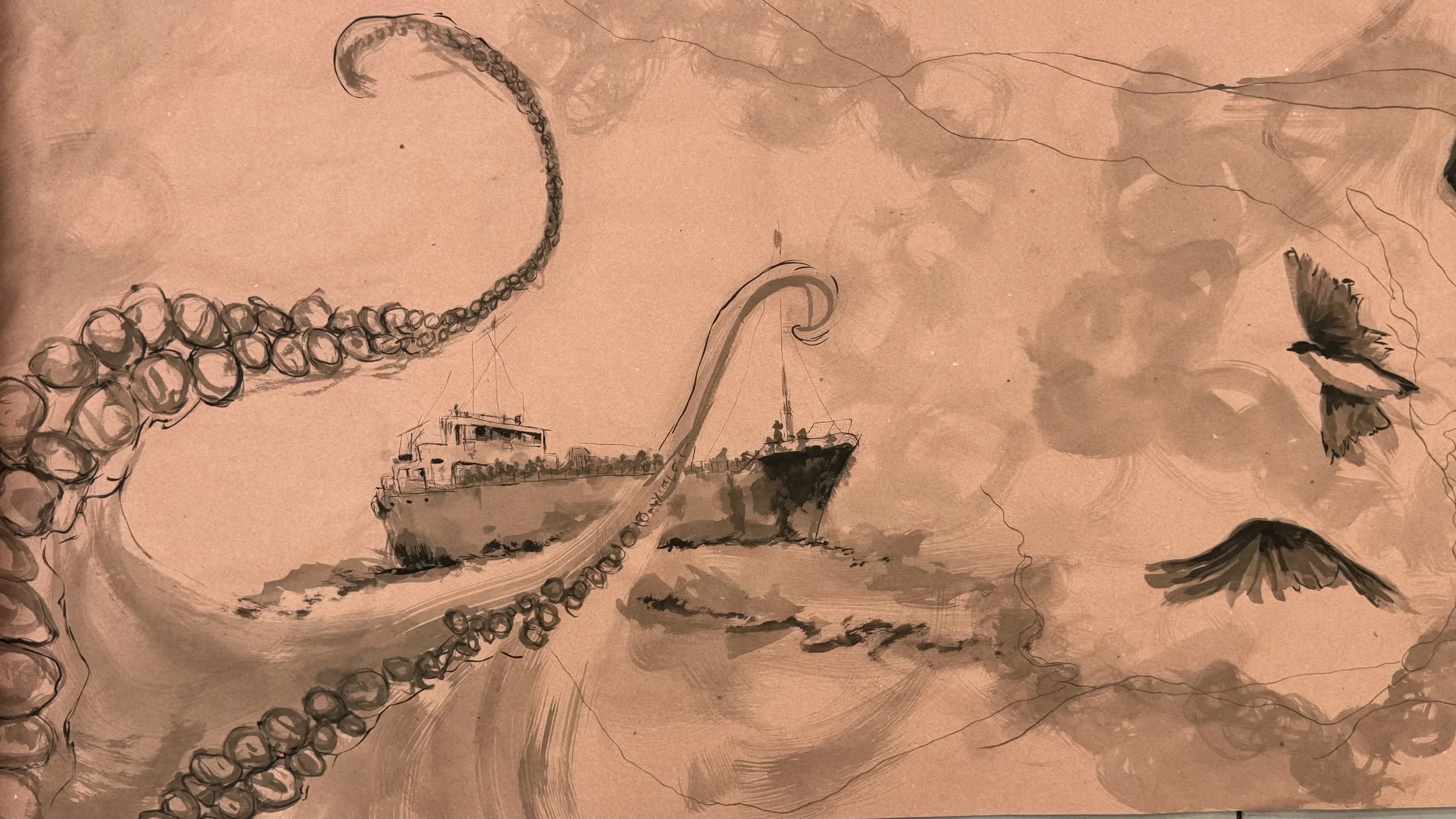
Detail of Slack Water
21 feet by 3 feet | sumí ink on rosin paper
On View at WaterFire Arts Center
475 Valley Street
Providence, RI 02908
July 2nd - Aug 27th, 2026
10am - 5pm Weds - Sun
Performances
Gallery Closing at WaterFire Arts Center: Thursday, August 27th 6:30 PM
Ritual Burning at WaterPlace Park: Saturday, August 29th 6:30 - 9 pm as part of WaterFire
In the summer of 1993, a ship called the Golden Venture ran aground off Rockaway Beach, New York. It was carrying 286 people from Fujian, China, who had paid smugglers for passage to the United States. Ten people drowned trying to swim to shore. The survivors were detained for years while their asylum claims moved through a system that was not built to aid them; decades later, some are still living in a kind of legal limbo, never having been granted full status.
I've been thinking about the Golden Venture for a long time, and it's the starting point for a body of work called Fata Morgana. It's also one of the sources for my new painting, Slack Water, which opens this July at WaterFire Arts Center's "America, Unfinished?!" exhibition in Providence.
I was a teenager in 1993 and the news coverage made a striking impression on me because I worried for the migrants and it happened in such an unusual place. It then sank into the depths of my memory. Thirty years later it surfaced during an art workshop, and I found myself wondering what had happened in the intervening time.
Rockaway Beach is also where, in recent years, Sei whales have died and washed ashore. Sei whales have been listed as endangered under the Endangered Species Act since 1970, and they migrate along this coastline. Piping plovers return to nest on the same beach every year, listed as endangered in New York State. As an enthusiastic birder, I've been going to the Rockaways for quite some time to find the plovers during nesting season. Most people are surprised that this stretch of New York City functions as a migration corridor at all. It's easy to forget that the five boroughs are entwined with a much older set of routes that predate the city, and that those routes are still active and often endangered, even as everything else around them has been radically transformed by human activity.
Slack Water also reaches across the ocean to the beginning of that journey. Fujian's coastline is its own migratory corridor, with herons and many other bird species as temporary visitors. The painting has no single fixed viewpoint, and elements are repeated in different orientations; it can be walked around and read from any direction, which seemed right for such a circuitous and looping journey.
Migration is, underneath everything, a natural phenomenon. Animals move with seasons, food, and climate. Humans do too, and have for as long as there have been humans. What's added to modern human migration is borders: policy, detention, the legal architecture that decides who belongs and who doesn't. The Golden Venture sits at exactly that intersection. It was a human movement toward opportunity and away from hardship that ran directly into a system designed to stop it.
J.M.W. Turner engaged in similarly complex territory when he painted Slave Ship in 1840, depicting the moment after a captain threw enslaved people overboard to collect insurance money for those "lost at sea." These are not equivalent histories — the people on the Golden Venture made a desperate choice whereas the people on Turner's ship had none — but Turner's painting taught me something about holding pathos and the sublime in the same frame. This painting has been a touchstone for me in this body of work because those conflicting qualities are conveyed through not just the ship and the figures; the water and sky are characters that carry so much of that weight.
None of these things – the migrants, the whales, the heron, the plovers – are related to each other in any literal sense, but they are all vulnerable and continually inscribed on the same shorelines. Contemplating them together through the creation of this work allowed me to make these oblique connections stronger.
The painting takes its title, Slack Water, from a real tidal phenomenon: the brief period when a tide is neither coming in nor going out. I'm drawn to it as a metaphor for the suspended state migrants occupy, between departure and arrival, between one legal status and another.
The physical form of the piece is a manifestation of forgetting. It's made on rosin paper, the kind contractors tape down to protect floors during construction, paper so ordinary that almost no one registers stepping on it. Visitors are allowed to walk on it for the full run of the show and it will degrade, visibly, the way memory degrades. Most people have never heard of the Golden Venture and the history has been worn down over thirty years. Inviting people to walk on the painting without a second thought makes that erosion physical. You're in the midst of the forgetting, in the same way most of us walk past this history altogether.
That unconsciousness will flip at the closing event of the exhibition on August 27th. What remains of the painting will be cut, folded, and burned, deliberately, by hand. Every year, my family visits our ancestors' graves and burns paper money and paper offerings, a way of replenishing what they might need in the afterlife. It's also an excuse for everyone to gather and talk about the people we've lost and to keep them present in conversation. Burning Slack Water comes out of that same impulse. The painting won't survive past August, but where the walking lets people forget without noticing, the burning is a ritual that deliberately leaves a mark in memory.
The exhibition's opening weekend falls on the 250th anniversary of the founding of the United States. "America, Unfinished?!" is, by its own title, asking what the country has and hasn't become. Slack Water is my answer to a small piece of that question: a record of people who were seeking a better and just life, and the cost they paid for the country deciding otherwise.
I'll be sharing the piece's progress throughout the run, including how it wears and changes under foot traffic, and documenting the closing burn on August 27th. If you're in Providence between July 2nd and then, I hope you'll go walk with it.
Further reading: Patrick Radden Keefe's A Path Out of Purgatory, on the aftermath for the Golden Venture's survivors.
